
Introducing Technician Field Assistant (TFA): Lower Service and Parts Costs Across Every OEM
Like having a senior tech with you on every call.
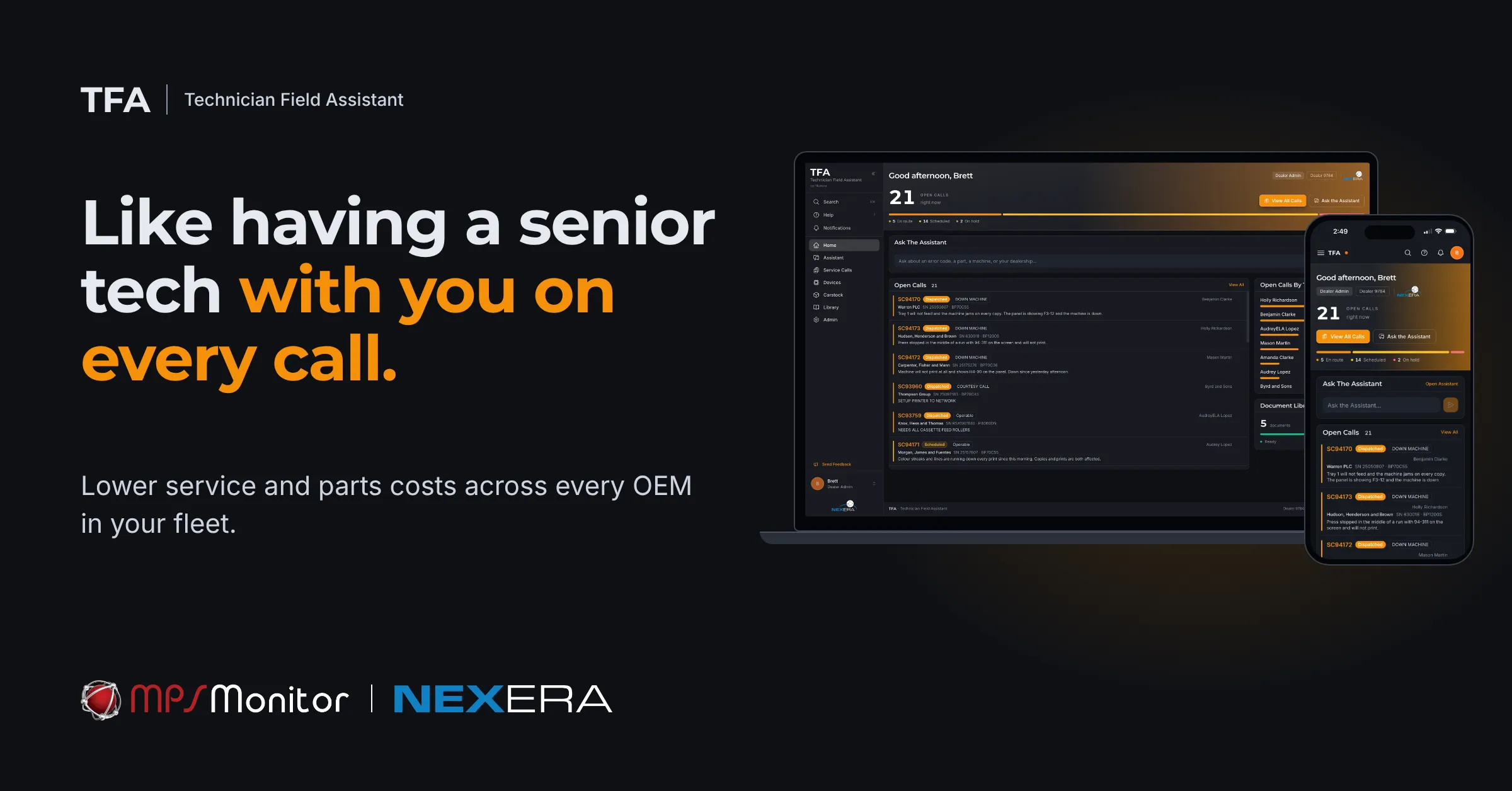
Today Nexera and MPS Monitor are launching Technician Field Assistant (TFA), an AI assistant built to help your technicians fix more machines on the first visit and keep the cost of return visits out of your service contracts.
What a return visit really costs
Every callback, every hold-for-parts trip and every part replaced on a guess comes out of the same place: the profit on your service contracts. A return visit costs roughly $100 in fuel and labor, before parts.
Nexera’s dealer benchmarks show how wide the gap is. The median dealer runs at 12.05% callbacks and 10.24% hold-for-parts visits. The top 20% of dealers run at 9.60% and 6.94%. A 25-technician dealer could save about $138,000 a year by moving from the median to that level, counting return visits only, before any parts savings or time saved on each call.
Assumes about 80 calls per technician per month. Illustrative estimate based on Nexera dealer benchmarks. Not a guarantee or a measured TFA result.
TFA is built to help close that gap: lower service costs, lower parts costs and more profitable service. You can try the numbers for your own team at tfa.nexera.net.
The answer is already in your data
Most of what a technician needs to fix a machine on the first visit already exists somewhere in the dealership. The trouble is where it lives. A typical dealer spreads it across seven places: the ERP and dispatch notes, the service history, device and DCA data, parts and carstock, the manuals, the experience of senior technicians, and the web. Nobody pulls those pieces together for a single call, so the technician searches, calls a colleague, or goes with a best guess.
TFA pulls these sources together on the technician’s phone or laptop, before they leave for the call.
What TFA does on a call
TFA connects to your ERP, and open calls flow in every few minutes with the dispatch note, customer, machine and assigned technician. As each call arrives, TFA builds a call briefing in the background, so it is ready when the technician opens it:
- Likely causes and what to check first, based on what fixed this problem before, on this machine, on this model at your dealership, and across the dealer community.
- The parts that actually fixed it, on this model across the dealer community, checked against the technician’s carstock. TFA says a part is “not in stock” only after it has checked, and shows which warehouses and technicians have it.
- The right manual page. Your technicians ask about an error code and TFA answers from your manuals, citing the exact page. One tap opens the manual at that passage, highlighted.
- Web sources. TFA searches for the most relevant public sources on the problem, reads them and summarizes the key takeaways with links, the same searching techs already do at the machine.
- Live device data for dealers that also use MPS Monitor: supply levels, counters, panel messages, alerts and maintenance-kit life, so the technician sees the machine’s condition before arriving.
On site, technicians ask follow-up questions in plain language (“When were the feed rollers last replaced?”) and get answers with dates, work orders and part numbers. Voice input works through the phone keyboard. TFA runs on the web, iPhone, iPad and Android, and each technician’s conversations with the Assistant stay private to that technician.
TFA doesn’t make the call. Your technician does.
“AI belongs in the hands of field technicians, but not to make their decisions for them,” said Brett Sisell, Head of Innovation, MPS Monitor and Nexera. “The knowledge a technician needs already exists, in years of service calls, manuals and device data. TFA uses AI to unlock it and bring it to the technician on every call. The AI doesn’t make the decision. It gives technicians the best information possible, at the moment they need it most, so they can make the best decision themselves.”
One assistant for every OEM in your fleet
Most dealers service machines from several OEMs, and TFA brings the same guidance to every call, whatever the badge on the machine says. An AI tool is only as good as what it reads: TFA draws on more than 70 million real service calls from across the dealer community, and more than 4 million of those calls have been fully analyzed by AI, reading the dispatch problem and the technician’s notes to capture what was wrong and what fixed it.
That breadth changes what a technician can see. As an example, your dealership might have about 50 calls for a given failure on a model. Nexera’s global service analytics might have thousands. OEM service tools cover their own manufacturer’s machines, and your technicians can keep using them. AI built into an ERP or a technician app sees only your own calls. TFA adds the real-world fix that technicians across many dealerships have recorded, next to the book fix in the manual, across the OEMs in your fleet.
Each dealer’s service history stays theirs. Global service analytics is privacy-protected, with personal details removed, and no dealer sees another dealer’s data. No AI model is trained on your data.
What changes for your service team
Technicians arrive knowing what to check and what to bring, and spend less time calling around or scrolling through a 640-page manual. A new technician gets senior-level guidance on every call.
Help desk technicians triage remotely with the same briefing, which helps when a customer is on the phone and the clock is running.
Service managers see team call queues and open calls by technician at a glance. A coverage report ranks the models with no manuals by call volume, so you can close the documentation gaps that cost the most calls.
Owners judge TFA on results: lower service costs, lower parts costs and more profitable service. TFA is designed to cut callbacks and hold-for-parts trips and the time spent on each call, and to keep years of call notes working for you when experienced technicians leave.
It also helps with parts spending. Technicians see which parts actually fixed a problem on a model, and in pilots they have gone with a part TFA surfaced from real repair history instead of the usual replacement. It cost far less and still fixed the problem. TFA is also designed to help new hires get productive sooner: one dealer service leader estimated it could have a new technician running basic calls in about a month instead of about eight months of ride-alongs (the dealer’s own estimate).
One dealer service manager summed it up as “like having a senior technician on every dispatch.”
Questions dealers ask
What does it take to get started?
A TFA subscription with a supported ERP connection, your list of users and your manuals. On-premise setups connect with a short agent install; cloud-hosted setups need an access request to the ERP provider. Setup time depends on your configuration, and we walk you through it.
Which OEMs does TFA work with?
TFA is built for multi-manufacturer fleets. Documentation matching works with any manufacturer’s manuals you upload, and live device data comes from supported devices on MPS Monitor.
Does TFA work with our ERP?
TFA connects to one ERP today. Tell us which ERP you use and we’ll tell you where it stands.
Do you supply the manuals?
No. OEM manuals are confidential to each dealer, so you upload your own. TFA handles whole manufacturer archives and removes duplicates automatically.
How accurate is it?
Answers from manuals cite the exact page. When TFA can’t back up a claim, it marks it unverified, and when an error code isn’t in your manuals, it says so instead of guessing.
Where TFA fits
Nexera has studied dealer service data since 1993, on a simple premise: data from across the dealer community can solve problems no single dealer could see alone.
TFA is the first product of Monitor to Manage™, the strategy bringing Nexera and MPS Monitor together.
“When MPS Monitor and Nexera came together, we knew we were in a rare position to help the whole industry raise the bar on service,” said Kevin Tetu, President, Managed Print Division, MPS Monitor and Nexera. “Connecting what the fleet is telling a dealer with what decades of service history have already taught us opens up a lot of room for healthier margins and better results. TFA is one example of that in action, putting it in the technician’s hands on every call.”
See TFA in action. Request a demo at tfa.nexera.net or write to sales@nexera.net.
Feature availability depends on supported integrations and manufacturer coverage.